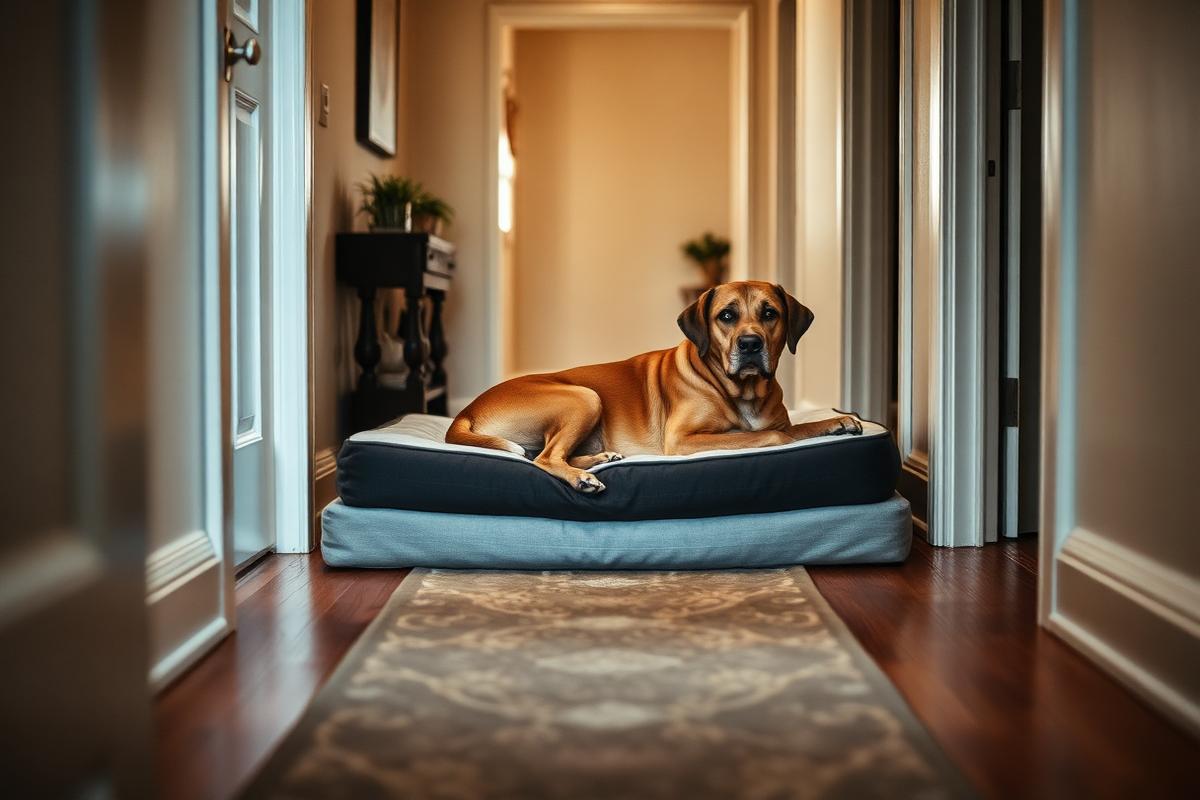
A dog losing mobility needs three things above all: secure footing on slippery floors, help getting up and outside without injury to either of you, and dry, clean skin. Most of it is practical rather than medical. What tends to catch families out is how quickly the physical work escalates.
This is often the point at which families in Abbotsford realise the situation has quietly become unmanageable. Getting the house right buys real comfort and, for many dogs, real time.
Start With the Floors
If you change one thing, change the footing. Laminate, tile and hardwood are the reason a great many dogs stop trying to stand. They slip once, they lose confidence, and after that they will not attempt it even when they could.
Lay a path along the routes they actually use, from bed to door to water bowl. Rubber-backed runners, yoga mats, interlocking foam tiles or cheap carpet tiles all work. Cover the corners where they turn, because turning is where the back end slides out.
Keep the fur between their pads trimmed and their nails short. Long nails change how the foot loads and reduce grip further, and this is genuinely one of the highest-value small fixes there is. Ask your veterinary team to do it if your dog will not let you.
Beds, Steps and Access
An older dog with weak hindquarters needs a bed they can step onto rather than climb into, and enough padding to protect bony points. Memory foam or a thick orthopaedic mattress helps more than a soft nest.
Put beds where the family is. A dog who cannot follow you from room to room ends up alone all day if their only bed is in the kitchen. Two or three thin beds around the house are often better than one expensive one.
Use a ramp for steps they can no longer manage, including into the car, and make it wide with a non-slip surface. Baby gates at the top of stairs prevent a fall that ends everything abruptly.
Raise food and water bowls if your dog struggles to lower their head, and keep water on every level they use.
Helping Them Up Without Hurting Either of You
Technique matters here, for your dog and for your back.
Support the chest and the hindquarters together rather than scooping under the belly, which is uncomfortable and can be harmful. A proper support harness with handles, or a towel folded lengthways under the belly just in front of the hind legs, gives you a controlled lift.
Ask your veterinary team to show you once in person. Two minutes of demonstration is worth more than any written description, including this one.
Protect yourself. Bend at the knees, keep the dog close to your body, and get help for a large dog rather than proving you can manage. A carer with an injured back cannot care for anyone, and this is the point where many families quietly reach their limit.
Toileting
Accidents in a previously clean dog are usually about access, not training. They cannot get up fast enough, cannot manage the step, or cannot hold the posture.
Take them out more often and on a schedule rather than waiting for them to ask. Use the harness to support them while they position themselves, since many dogs cannot balance to squat. Consider a sheltered patch close to the door for wet Fraser Valley winters, when a long walk to the far end of the garden is a serious undertaking.
Use washable pads indoors and change them promptly. Do not scold. It is not defiance, and a dog who becomes anxious about accidents will start hiding them.
Skin, Hygiene and Pressure Points
A dog who cannot shift position is at risk of sores over hips, elbows and shoulders. Check those points daily for redness or hair loss, and add padding before they break down rather than after.
Help them change position every few hours if they cannot manage it themselves. Keep the back end clean and dry, trim the fur there on long-coated dogs, and dry thoroughly after any wash. Damp skin breaks down fast and is genuinely uncomfortable.
Report any sore, wound or persistent redness to your veterinarian rather than treating it at home.
Movement, Weight and Stimulation
Short and frequent beats long and occasional. Several brief outings usually suit a dog with mobility loss better than one walk that leaves them wrecked for two days.
Weight matters more now than at any other time in their life, since every extra kilogram is carried by joints that are already struggling. Ask your veterinarian what your dog should weigh and how to get there safely.
Do not forget their mind. A dog who cannot walk far can still sniff, work at a food puzzle, sit outside and watch the street, or ride somewhere in the car. Boredom looks a lot like decline.
Any exercise plan, and anything for discomfort, should come from your veterinarian. Never give a dog human painkillers. Report reluctance, stiffness after rest, restlessness at night and any new intolerance of handling, since those are the signals that most often go unmentioned.
When Managing It Is No Longer Possible
There is usually a point families can name afterwards. The day lifting became a two-person job and only one person was home. The night nobody slept. The morning the dog could not get up at all and lay in it for hours.
Reaching that point is not a failure of effort, and being tired does not disqualify your judgement. If your dog cannot stand, cannot get outside, or seems distressed rather than simply tired, that is the moment to talk to a veterinarian rather than to push through another week. There is also a real practical argument for a goodbye that happens at home when a dog can no longer be lifted into a car at all.
Frequently Asked Questions
What is the single most useful change I can make? Non-slip footing on the routes your dog uses, plus short nails and trimmed paw fur. Confidence on the floor changes everything else.
How do I lift a large dog safely? Support chest and hindquarters together with a harness or a folded towel sling, never under the belly alone. Have your veterinary team demonstrate it once.
My dog is having accidents indoors. Is he giving up? Usually it is an access problem rather than a behavioural one. More frequent trips and physical support solve many cases.
Should I still walk him? Usually yes, but short and often rather than long. Ask your veterinarian what is appropriate for your dog specifically.
How do I know when it is too much? Look at whether your dog can stand, get outside, stay clean and rest comfortably, judged over a run of days rather than one good morning.
Published by the team at Home Euthanasia Veterinary Services.
This article is provided for general information and is not a substitute for veterinary advice about your own pet. If your pet is in distress or you are worried about their comfort right now, please contact your regular veterinarian or your nearest emergency animal hospital.